How to Choose the Right PPF for Your Car
Paint protection film (PPF) is a clear urethane layer that takes stone chips, parking scrapes and sun damage instead of your paint. But "PPF" is not one product. Coverage, film grade, finish, warranty and the installer all vary, and together they matter more than the brand name on the roll. This guide takes each decision in the order that actually drives the result. When you want to see the options ARMOR fits, our PPF service in Sharjah sets them out.
What does paint protection film actually do?
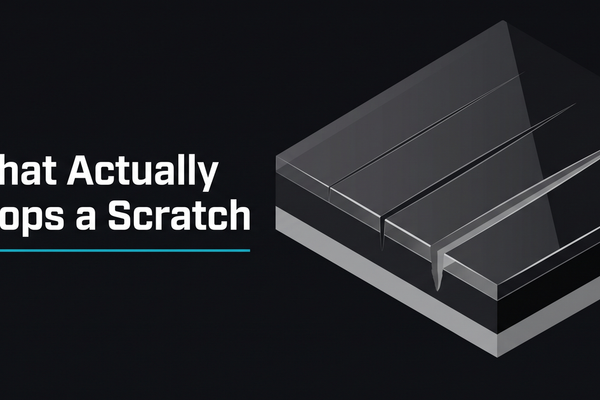
Paint protection film is a sacrificial layer. It absorbs stone chips, light scratches, door-edge scuffs, bird droppings and UV so the paint underneath does not have to. A typical film is built in layers: a protective cap sheet removed at installation, a flexible self-healing polyurethane top coat, a roughly 6 mil impact-resistant urethane body, an acrylic adhesive and a release liner. That is the construction one manufacturer's technical data sheet for its matte film describes.
The self-healing top coat lets fine wash swirls fade with warmth. A chip or cut that goes through the film does not heal. The film takes that damage instead of the paint, and a damaged panel can be re-filmed.
How much of the car should you cover?
Coverage is the biggest decision and the biggest driver of cost. There is no single correct amount. It depends on where your car takes damage and how long you plan to keep it.
| Coverage | Panels covered | Best for | Left exposed |
|---|---|---|---|
| High-impact spots | Door-handle cups, door edges, mirrors, headlights, rear loading lip | Older cars, tight budgets, protecting known trouble spots | Bonnet, bumper face and most panels |
| Front-end kit | Full front bumper, bonnet, front wings, mirrors, headlights | Daily drivers with highway mileage | Doors, roof, rear panels |
| Full body | Every painted panel | New, premium or leased cars, long ownership, resale | Nothing painted |
A front-end PPF package covers the panels that catch almost all road debris at a fraction of full-body cost. A full-body PPF package is for owners who want no panel left to chip, fade or age differently from the rest.
What should you check in the film itself?
Before you book, ask for the film's specifications: material, thickness, top coat and warranty terms. A premium film's technical data sheet states all of them, plus its test results. A shop that cannot answer these is asking you to buy on trust.
| What to check | What a good answer looks like | Why it matters |
|---|---|---|
| Material | Thermoplastic polyurethane (TPU), ideally aliphatic | Decides flexibility, impact absorption and yellowing resistance |
| Thickness | Roughly 7–8 mil total film (about 180–200 microns), stated on the data sheet | More urethane absorbs more impact energy from road debris |
| Top coat | Self-healing, stain- and chemical-resistant, often hydrophobic | Keeps the surface clear of swirls, water spots and staining |
| Test data | Gravel-impact, weathering and heat results listed | Shows the film was tested, not just described |
| Warranty | Years, what it covers, and who backs it, in writing | A film warranty is only as good as its terms |
On thickness: film is measured in mil, thousandths of an inch (1 mil is 25.4 microns). One clear film's data sheet lists 8 mils, and the matte film's sheet quoted above lists 7–8 mil without liner or cap sheet. A third manufacturer's data sheet quotes a 6.5 mil (165 micron) face film on a 2 mil adhesive, and a pass in the SAE J400 gravel-impact test.
On material: "TPU" alone is not the whole story. One supplier of the urethane used in paint protection films sells its colour-stable aliphatic TPU specifically for UV resistance and non-yellowing colour stability. The 8-mil film's data sheet likewise describes it as aliphatic TPU "extremely resistant to yellowing and UV exposure". Ask whether the film is aliphatic.
Gloss or matte: which finish should you choose?
Choose gloss if you like your paint as it is: clear gloss film is close to invisible and keeps the factory shine. Choose matte for a satin look without a respray. One manufacturer describes its matte film as one that "transforms the appearance of traditional paint to a matte finish". Factory matte or satin paint needs matte film too, or the film adds shine the paint never had. At ARMOR, gloss is standard and matte is available on request.
Does PPF hold up in UAE heat and sun?
Yes, if the film is built for it. Heat and UV are exactly what separate a premium film from a cheap one. Manufacturers say so themselves: one rates its film for up to 7 years of durability, and its data sheet cuts that by two years for high-sun US regions including Arizona, Nevada and Hawaii. Sharjah's summers are the same kind of hot, high-UV exposure.
The matte film's data sheet reports no detrimental effect after 2,500 hours at 70 °C and 2,500 hours of accelerated UV weathering. Ask for that kind of result. Shade parking and gentle washing extend a film's life. The UAE sun also helps the self-healing top coat: the warmth that bakes a car in July is the same warmth that levels out fine swirls.
What does a PPF warranty actually cover?
A PPF warranty covers the film failing, not the film doing its job. The matte film quoted above carries a manufacturer's 5-year limited warranty "covering cracking, bubbling or discolouring". Another manufacturer's data sheet treats abrasion and loss of gloss as normal wear, not covered, and says soaps, waxes or coatings containing petroleum distillates or solvents void its warranty.
ARMOR's premium PPF carries up to an 8-year warranty covering manufacturing defects and installation-related issues such as yellowing, peeling and adhesion problems. Whoever you use, ask how many years, what exactly is covered, and whether the manufacturer, the shop or both stand behind it. Get it in writing.
Not sure which coverage and film fit your car? Ask us.
Message us on WhatsAppHow do you match PPF to the way you drive?
Start from your driving, not the brochure. A daily Sharjah–Dubai highway commute throws stone chips and sand at the front end, so a front-end kit is the sensible minimum. A new or leased car you will sell or hand back is the strongest case for full body. A garage-kept weekend car may only need the impact points covered. An older car can take PPF too, but polish and correct the paint first: film protects whatever is underneath it, swirls included.
Why does the installer matter as much as the film?
A premium film installed badly looks worse than a mid-range film installed well. Lifted edges, trapped dust and visible seams are installation faults, not film faults. Good installation means a decontaminated, corrected surface; a clean bay; and film wrapped around panel edges wherever the panel allows, so there is no exposed line for dirt to creep under. Hand-trimmed or pre-cut patterns can both work, as long as the installer knows where each panel's edges are wrapped and where they are cut.
Time is part of the job too. At ARMOR, full-body PPF usually takes 4–7 days depending on the size of the car, and the car rests for at least 24 hours so the film bonds fully. Questions worth asking any installer:
- What is the film made of, how thick is it, and can I see the specifications?
- Are the edges wrapped, and where are they cut?
- How long will the car stay with you, including cure time?
- Who backs the warranty, and is it in writing?
- Can I see a car you have finished?
PPF, ceramic coating, or both?
They solve different problems. PPF is a physical layer against chips and scratches. A nano-ceramic coating makes the surface slick, adds gloss and makes washing easier, but it will not stop a stone chip. Many owners combine them: PPF on the high-impact front end, ceramic over the rest. Our comparison of PPF, ceramic coating and polishing sets the three side by side.
Which PPF brand is best?
There is no single best brand for every car. The data sheets quoted in this guide come from three different manufacturers, and all of them describe a urethane film of roughly 6.5–8 mil under a self-healing top coat, tested for impact and weathering. Between premium films, what differs most is the warranty terms, the finish options and the installation. Compare films on the five checks in the table above, not on the logo.
Frequently asked questions
How long does PPF last in the UAE? It depends on the film, the care and the warranty behind it. Manufacturer ratings are typically 5–7 years, and one manufacturer shortens its rating in high-sun regions. ARMOR's premium PPF carries up to an 8-year warranty against yellowing, peeling and adhesion problems.
Can PPF be applied to a used car? Yes, once the paint has been corrected. Film protects whatever is underneath it, so swirls and scratches should be polished out first. A used car with sound paint is a good candidate for a front-end kit.
Does PPF turn yellow on a white car? Discolouration is easiest to see on white and light paint, so the film choice matters more there. Choose an aliphatic TPU film and a warranty that names yellowing or discolouring explicitly.
Can I wash my car normally after PPF? Yes, with the right products. Avoid soaps, waxes and coatings containing petroleum distillates or solvents; at least one manufacturer says they void its warranty.
Not sure which PPF fits your car? Ask us
Tell us your car, how you drive it and what you want to protect, and we will recommend coverage and film with no obligation to book. If a front-end kit is all your car needs, you will hear that too.
Armor Car Care Center — Basement Parking, 06 Mall, Al Badee Rd, Al Juraina, Sharjah Tel: +971 58 211 8700
See the full coverage options and what the warranty covers on our paint protection film page. Ready to go ahead? Book a slot.