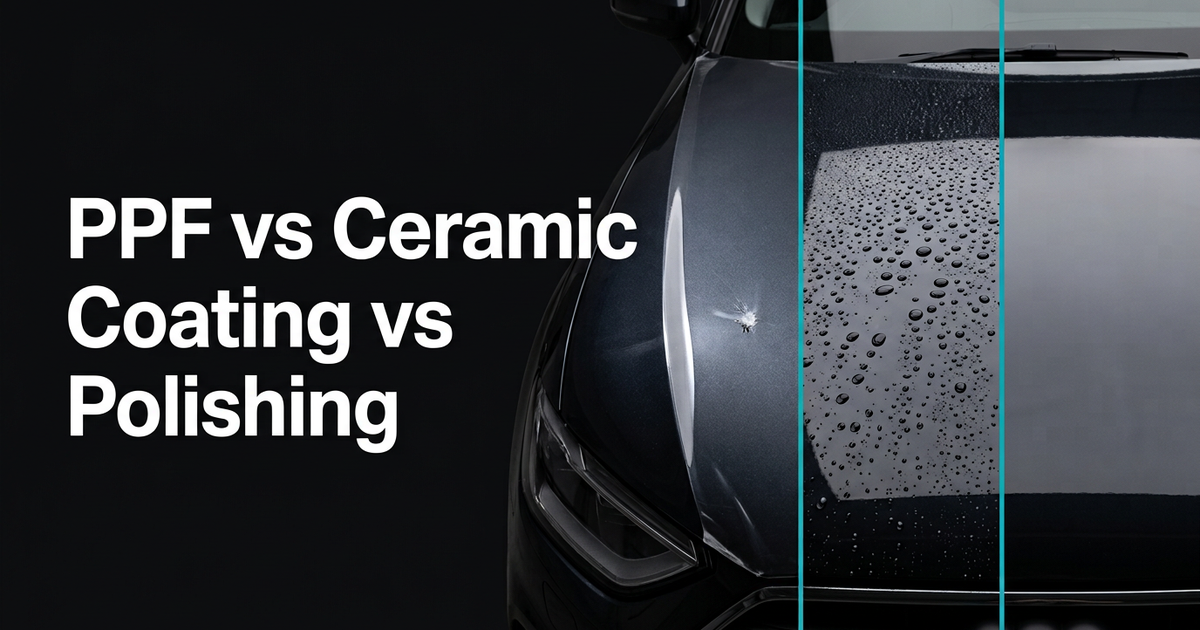
PPF vs Ceramic Coating vs Polishing: Which Does Your Car Actually Need?
If you have asked three shops in Sharjah what your car needs and received three different answers, that is not a coincidence — a shop that fits one product tends to recommend that product. The honest answer is that PPF, ceramic coating and polishing solve three genuinely different problems, and the right choice depends on what your paint looks like today and what you are trying to prevent tomorrow. At ARMOR Car Care we fit all three, which means we have no reason to push you toward one.
Here is what each actually does, where each fails, and how to work out which your car needs.
What does paint protection film actually do?
Paint protection film is a clear thermoplastic polyurethane layer bonded over your paint, typically 150–200 microns thick (6–8 mil). It is a physical barrier. When a stone thrown up by the car ahead of you on Al Badee Road hits the film, the film absorbs the impact and your paint underneath stays untouched.
Premium films are self-healing: the topcoat is engineered to reflow when warmed, so light swirls and fine scratches in the film close up on their own. This works particularly well in the UAE, because surface temperatures on a parked car routinely exceed what the film needs — you do not need a heat gun, only sunlight.
What PPF does not do especially well is make your car easier to wash. It is protective, not slippery.
What does nano-ceramic coating actually do?
Nano-ceramic coating is a liquid silica-based polymer that cures into a hard, transparent layer on top of your clear coat — roughly 1–3 microns thick. That is around one-hundredth the thickness of PPF, which tells you most of what you need to know about impact protection: there is essentially none.
What it does exceptionally well is change how your paint behaves. Water beads and sheets off instead of sitting and drying. Dust and sand release more easily, so washing takes less effort and less contact — which matters more than it sounds, because most swirl marks in this region are created during washing, not driving. It also resists chemical etching from bird droppings and hard-water spotting, both of which act fast in UAE heat.
A properly maintained coating typically lasts 2–5 years, depending on the product and the wash routine.
One thing worth clearing up: coatings are often marketed with a "9H" hardness figure. That number comes from a pencil-hardness scale applied to the coating film in laboratory conditions. It is not a real-world scratch rating, and it does not mean your paint cannot be scratched.
What does polishing actually do?
Polishing — properly called paint correction — is abrasive. Machine polishers and progressively finer compounds level the clear coat down to the base of each defect, which removes swirl marks, wash scratches, oxidation and light water-spot etching.
The word that matters is removes. Correction does not add anything to your car; it takes a few microns of clear coat away to make the surface flat again. Since a modern factory finish carries only around 40–60 microns of clear coat in total, this is a finite resource. A car can be corrected several times over its life — not indefinitely.
This is why polishing is best understood as the step *before* protection, not an alternative to it.
PPF vs ceramic coating vs polishing: side by side
| Paint Protection Film (PPF) | Nano-Ceramic Coating | Polishing / Paint Correction | |
|---|---|---|---|
| What it is | 150–200 micron polyurethane film | 1–3 micron silica-based coating | Abrasive removal of clear coat |
| Main job | Stops physical damage | Repels water, dirt, chemicals | Removes damage already present |
| Stone chips | Yes — the only one that does | No | No |
| Swirls & light scratches | Resists, and self-heals in heat | Mild resistance only | Removes them |
| Bird droppings & etching | Blocks contact with paint | Strong chemical resistance | Removes existing etching |
| Sun fade / UV | Blocks UV at the film | Strong UV resistance | No ongoing protection |
| Makes washing easier | Marginally | Significantly | No |
| Typical lifespan | 5–10 years | 2–5 years | Not applicable — one-time correction |
| Adds or removes material | Adds a layer | Adds a layer | Removes** clear coat |
| Relative cost | Highest of the three | Middle | Lowest of the three |
So do they compete, or work together?
They work together, and the order is not arbitrary.
Correct first, then protect. Both PPF and ceramic coating are transparent and sit on top of whatever is underneath. Applying either over swirled, etched or oxidised paint locks that damage in and makes it more visible, not less — you have sealed the defects under a glossy layer. Any defects worth removing should be polished out before protection goes on.
Then protect against the two different threats. PPF handles impact; ceramic coating handles chemistry and cleaning. They are frequently combined: film on the high-impact areas — front bumper, bonnet, wing mirrors, A-pillars — and coating over the whole car, including over the film itself, so the entire vehicle behaves the same way when you wash it.
Which one does your car actually need?
A new car, taken from the showroom. The paint is already close to perfect, so correction is largely unnecessary. This is the ideal moment for protection, before the first stone chip and before the first bad wash. PPF on the impact zones, coating over the rest. Protecting a new car is always cheaper than correcting an older one.
A one- to three-year-old car in daily use. Expect light swirls from washing and some sand-related dulling. A single correction stage followed by a ceramic coating usually returns most of the gloss and locks it in. Add front-end PPF if the car spends time on the highway.
A car with visible chips on the bonnet and bumper. Chips cannot be polished out — polishing removes clear coat, and a chip has already gone through it. PPF prevents the next ones. Existing chips are a separate paint repair.
A car being prepared for resale. Correction gives the biggest visual return here. A resprayed panel shows up in an inspection and affects value; a well-corrected original panel does not.
A car that is simply hard to keep clean. That is a ceramic coating problem, not a PPF problem.
Not sure which fits your car? Send us a photo on WhatsApp and we will tell you honestly what it needs — including if the answer is "less than you think."
Message ARMOR on WhatsAppWhat none of the three will do
Being straight about the limits is more useful than overselling:
- None of them make your car scratch-proof. PPF resists and self-heals light marks; a deep key scratch will still go through.
- None of them replace washing. A coated car gets dirty; it just cleans up faster and with less contact.
- None of them fix damage that has reached the base coat. Once colour is exposed, it is a paint repair, not a protection or correction job.
- Coating over unprepared paint makes things worse, not better.
Frequently asked questions
Can you apply ceramic coating over PPF? Yes, and it is common. Coating the film gives the whole car consistent hydrophobic behaviour, so filmed and unfilmed panels wash the same way. It also helps keep the film itself cleaner.
Do I need to polish before PPF or ceramic coating? If the paint has visible swirls, etching or oxidation, yes — both products are transparent and will lock in whatever is beneath them. On a new car with sound paint, a light preparation is usually enough.
How many times can a car be polished? A modern factory finish carries roughly 40–60 microns of clear coat, and each correction removes a few microns. That allows several corrections across a car's life, not unlimited ones. This is the strongest practical argument for protecting paint early instead of correcting it repeatedly.
Does PPF turn yellow? Older films did. Modern premium films use UV-stable topcoats and should not yellow within their rated life. Yellowing is normally a sign of a low-grade film or a film kept well past its lifespan.
Which lasts longest? PPF, at 5–10 years for a premium film, against 2–5 years for a ceramic coating. Polishing is not a protective layer, so it has no lifespan — its results last until new defects appear.
Is ceramic coating enough on its own for UAE conditions? For sun, dust, chemical etching and ease of washing, a coating handles the job well. For stone chips on the front end — the most common paint damage on UAE highways — it does nothing. That is what film is for.