The Complete Guide to Car Polishing: What It Fixes, What It Costs You
The short verdict: if your paint looks dull, hazy, or covered in fine spider-web scratches under direct sun, polishing will fix it properly and permanently. If it has deep scratches, chips, or faded plastic trim, polishing is the wrong tool and will not touch them. The honest question is not *which polish* — it is *how much correction your paint can afford*, and our paint correction and polishing service starts with measuring exactly that.
What does car polishing actually do?
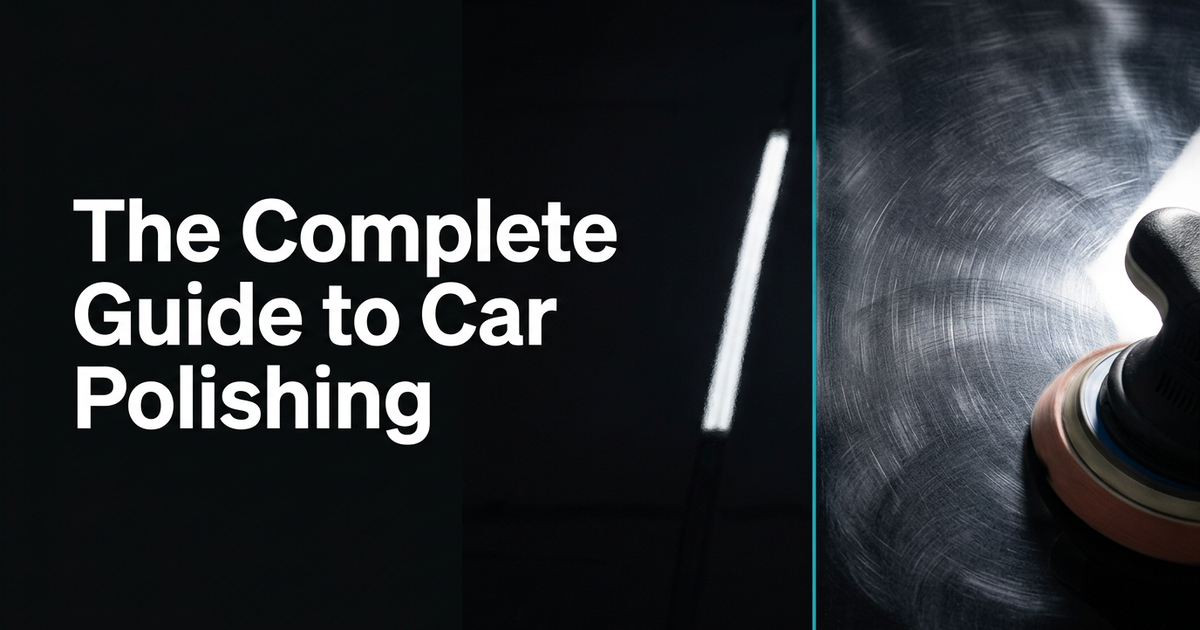
Polishing is controlled abrasion. A machine polisher drives a pad carrying an abrasive compound across the clear coat, cutting away an extremely thin layer of it. Scratches are not filled — the surface around them is lowered until they no longer exist.
That is why polishing produces a permanent result where a wax or a glaze produces a temporary one. It is also why polishing has a hard limit that nothing else in detailing has.
Three terms get used interchangeably and should not be:
- Compounding — the aggressive stage. Heavy cut, removes the most material, leaves its own fine marks behind that need refining.
- Polishing — the refining stage. Less cut, removes compounding marks, brings up gloss.
- Glazing / waxing — no meaningful cut. Fills and conceals temporarily. Washes away.
A shop offering "polishing" at a suspiciously low price is often selling the third one. It looks identical for about two weeks.
What can polishing fix, and what can't it?
The fingernail test settles most of it. Run a fingernail lightly across the defect. If it catches, the damage is through the clear coat, and polishing will not remove it — levelling that much material would take more clear coat than the panel can spare.
| Polishing fixes it | Polishing improves it | Polishing cannot fix it | |
|---|---|---|---|
| Swirl marks / spider-webbing | Yes — this is the core use case | — | — |
| Oxidation and dullness | Yes | — | — |
| Water-spot etching | Yes, if the etch is shallow | Deeper mineral etching | Etching that has reached the paint |
| Light scratches | Yes — fingernail does not catch | — | — |
| Deep scratches | — | Edges softened, less visible | Yes — needs paint |
| Stone chips | — | — | Yes — needs paint or PPF going forward |
| Faded plastic trim | — | — | Yes — different process entirely |
| Clear coat failure / peeling | — | — | Yes — needs respray |
Water-spot etching deserves its own note here, because in this market it is the single most common reason a car comes in. Hard water and mineral-heavy dust dry on hot paint and leave mineral deposits that bond and then bite into the clear coat. Caught early it is a wash-and-decontaminate problem. Left through a summer of hot afternoons, it becomes a polishing problem. Left longer, it becomes a paint problem.
How many times can a car be polished?
This is the question almost nobody asks and everybody should.
A factory clear coat is typically around 40–50 microns thick. Manufacturers and refinishers generally treat roughly 25 microns of remaining clear as the floor below which the coat can no longer protect the colour beneath it and is at risk of failure.
Work the arithmetic. A light one-step enhancement might remove 1–2 microns. A heavy multi-stage correction on neglected paint can remove 3–5. That gives a typical car somewhere in the range of three to five full corrections across its entire life — not per year, in total.
This is the case for measuring before cutting. A paint depth gauge reads what is actually left on each panel, which matters enormously on a used car where a previous owner or a body shop may already have spent that budget. Resprayed panels in particular can carry either far more material or far less than factory, and there is no way to know by looking.
Any shop willing to run a heavy correction without measuring first is spending a resource that does not belong to them.
One-step enhancement or full paint correction?
Most people asking for "a polish" are choosing between these two without knowing there is a choice.
| One-step enhancement | Two-stage correction | Multi-stage correction | |
|---|---|---|---|
| What it does | Boosts gloss, removes light swirls | Removes the large majority of defects | Chases near-perfection panel by panel |
| Defect removal | Roughly 50–70% | Roughly 80–90% | 90%+ |
| Clear coat used | Minimal — 1–2 microns | Moderate | Highest — 3–5 microns |
| Time in the shop | Part of a day | A full day or more | Several days |
| Cost band | Entry | Mid | High |
| Best for | Cars in decent condition; lease returns; maintenance between corrections | Daily-driven cars with a few years of wash damage | Show cars, dark paint, resale preparation, genuine enthusiasts |
What drives the price is not the polish itself — it is the condition you start from, the hardness of the paint, the size of the car, and how much of the work is edges, trim and tight panels rather than open flat surfaces. Soft paint corrects quickly and marks quickly. Hard paint resists both. Two identical-looking cars can be a day apart in labour.
Not sure which your car actually needs? Send us a photo of the paint in direct sunlight and we will tell you honestly — including when the answer is "a proper wash, not a correction."
Message us on WhatsAppWhy polishing alone is a half-finished job here
A freshly corrected car is at its most vulnerable. The clear coat is clean, level and completely unprotected — and it is about to be parked outside in Sharjah.
Everything that caused the original damage is still in the environment: mineral-heavy water, fine abrasive dust, UV, and heat that bakes contaminants onto the surface within minutes. Without a protective layer on top, the car begins re-accumulating water spots and wash marring immediately, and you spend your finite clear coat budget again far sooner than you should.
This is why correction and protection are sold together, and it is not an upsell. The sequence matters in one direction only:
- Decontaminate — wash, chemical decontamination, clay if needed. Never polish contaminated paint; you grind the contamination in.
- Measure — paint depth per panel.
- Correct — the minimum aggression that achieves the goal.
- Protect — a coating or film, applied to the corrected surface.
Applying protection *before* correcting locks the defects in under it. It is one of the few genuinely irreversible mistakes in detailing, and it means removing the protection you just paid for.
Which protection follows depends on what you are protecting against — ceramic coating for chemical resistance and easier washing, paint protection film for physical impact. The full comparison is in PPF vs ceramic coating vs polishing, and if film is where you are leaning, how to choose the right PPF covers the selection.
How often should you polish your car?
As rarely as you can get away with, and that is the goal, not a compromise.
For a protected, properly washed car in this climate: a light enhancement every two to three years, and a genuine correction only when there is a genuine reason — sale, a bad season, a wash that went wrong.
The variables that actually decide it: whether the car is parked covered or in the open, whether it is washed by hand with two buckets or by an automatic brush tunnel, and whether it carries a protective layer. Automatic brush washes are the single largest source of swirl marks we see, and no polishing schedule can outrun them.
Choose the right one
- Choose a one-step enhancement if your paint is in reasonable shape, you want gloss back, and you would rather preserve clear coat than chase perfection.
- Choose a two-stage correction if the car is a few years old, daily-driven, and shows visible swirling in sunlight — this is the right answer for most cars.
- Choose a multi-stage correction if the paint is dark, the car is being sold or shown, and you have confirmed there is depth to spend.
- Choose none of them if your paint is contaminated but undamaged. A decontamination wash costs a fraction and may be the entire answer.
- Do not polish at all if the clear coat is failing or peeling. Polishing accelerates it. That car needs a body shop.
Frequently asked questions
What is the difference between polishing and waxing? Polishing abrades a thin layer of clear coat to permanently remove defects. Waxing adds a temporary sacrificial layer on top and conceals rather than removes. Polishing changes the paint; waxing covers it.
Does polishing remove scratches? It removes scratches that sit within the clear coat — the ones a fingernail does not catch. Anything deeper needs paint, because levelling it would remove more clear coat than the panel can safely give up.
How many times can a car be polished? Roughly three to five full corrections in the car's lifetime, based on a factory clear coat of about 40–50 microns and a practical floor around 25. A paint depth gauge is the only way to know where a specific car stands.
Can polishing damage my car? Yes, if done without measurement or with too much aggression — burning through clear coat on an edge is permanent and needs a respray. This is why depth readings and the least aggressive effective method matter more than the product used.
Should I polish before ceramic coating or PPF? Yes, always. Both are transparent and permanent-ish layers; anything left in the paint underneath is sealed in and visible for the life of the coating or film.
Is machine polishing better than hand polishing? For correction, yes — hand polishing cannot generate the consistent cut needed to level a defect. Hand application remains appropriate for waxes, sealants and tight areas a machine cannot reach.
Find out what your paint actually needs
We measure paint depth before we cut anything, and we will tell you when the honest answer is a wash rather than a correction. That conversation is free.
Armor Car Care Center — Basement Parking, 06 Mall, Al Badee Rd, Al Juraina, Sharjah Tel: +971 58 211 8700
See what paint correction and polishing involves, or book a slot and bring the car in.