Is Paint Protection Film Worth It in the UAE?
"Is it worth it?" is the right question, and the answer depends on three things about your car that no sales page knows: where it sleeps, how far you drive it, and how long you are keeping it. Below are the figures manufacturers publish, the exclusions their warranties carry, and the cases where the honest answer is no. If film is already what you want, our paint protection film service in Sharjah sets out coverage and warranty.
Does paint protection film actually work?
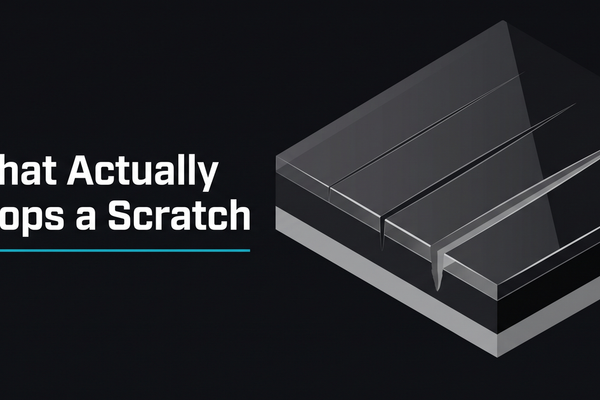
Yes, against impact and abrasion, and the mechanism is thickness. Paint protection film is a clear polyurethane sheet bonded over the paint. One manufacturer's data sheet lists the film with its adhesive at 0.19 mm — 7.5 mil — with a self-healing top layer whose fine scratches "disappear with heat applied to the film surface", which here means an afternoon in the sun.
That is testable rather than claimed: another manufacturer's data sheet records a pass on SAE J400, the laboratory gravel-impact test for chip resistance, and a service range to 100°C.
What film does not do is make a panel invulnerable. A stone hard enough to go through 0.19 mm of urethane reaches the paint, and nothing on the surface stops a door from denting metal. Film changes what a knock costs: a mark in a sacrificial layer instead of a chip in factory paint.
What does UAE heat and sand actually do to paint?
Two things, in different ways. The heat is relentless rather than dramatic: the UAE National Center of Meteorology's climate normals for Dubai, published through the World Meteorological Organization, put the mean daily maximum at 40.6°C in July and 40.4°C in August, with six consecutive months — May to October — averaging 35°C or higher.
The sand is abrasive and works at speed. Airborne grit sandblasts a car's leading edges: bumper, bonnet lip, mirrors, headlight lenses. That is why damage here concentrates at the front instead of spreading evenly, and why coverage matters more than film choice.
Manufacturers price the sun in. The data sheet above rates its film for up to 7 years, then notes that New Mexico, Nevada, Arizona, Colorado, Southern California and Hawaii "will have a 2-year reduction in durability" — its sunniest markets. Nobody publishes a Gulf figure, but the direction is not in doubt.
How long does PPF last in the UAE?
Expect roughly 8 to 10 years from a premium film fitted properly in the UAE, and treat the top of that range as conditional on sun exposure and your wash routine rather than a promise. The film ARMOR fits is rated 8 to 10 years and carries an 8-year warranty against yellowing, peeling and adhesion problems.
What ends a film's life here is usually the sun, not a stone, and the failure is cosmetic: yellowing, haze, or cracking at the edges. The data sheet that rates 7 years lists what shortens it — "angle and direction of the sun, environmental conditions, cleaning & maintenance" — and warns that products containing petroleum distillates or solvents, "such as soaps, waxes, or protective coatings, void any warranty". Three habits decide which end of the range you get: where the car sleeps (covered parking is the biggest single variable), what you wash it with (the data sheet asks for a wet, non-abrasive, solvent-free cleaner at pH 6 to 8, and rules out abrasive polishes and rubbing compounds, which "will damage the film surface"), and whether the edges are maintained (lifting edges let sand under the film, and they are the first thing a warranty inspection looks at).
Front end, full body or nothing: what are you buying?
Coverage is the real decision, not the film:
| Option | Panels filmed | What it addresses | Left exposed | Best for |
|---|---|---|---|---|
| Front end | Bumper, bonnet, front wings, mirrors, headlights | Nearly all stone chipping and sand abrasion, which lands on the leading edges | Doors, sides, rear, roof | High-mileage highway cars; covering the damage that is certain and no more |
| Full body | Every painted panel, plus add-ons like door handles | Stone chips plus parking damage: door-edge marks, curb scrapes, trolley scuffs | Nothing painted, though a hard knock still dents metal | Tight car parks daily; dark or soft paint; keeping the car five years or more |
| High-wear panels | Handles, mirrors, door edges, headlights, boot lip | The one mark you keep finding on your own car | Everything else | Low-mileage cars with a single recurring problem |
Our front-end PPF package is where most owners start, because it matches where the damage lands. The fourth option — no film — is covered further down.
Not sure whether your car needs the front end, the whole body, or nothing yet? Tell us the car and how you drive it, and you will get a straight answer.
Message us on WhatsAppWhat are the drawbacks of paint protection film?
Five, and a shop that lists none of them is selling rather than advising.
- It is money up front against damage that is only probable. If the car never meets it, you paid for nothing — true of insurance too, which is the right frame.
- The warranty excludes the damage the film stops. One manufacturer's limited warranty runs ten years from installation against yellowing, cracking, blistering and delamination, then excludes "stains, and scratches", water spots from mineral deposits, abrasion from automatic car washes, and "damages caused by outside forces, including the physical impact of rocks or road debris". The film is the sacrificial part: taking a hit is it working, not failing.
- It constrains how you wash the car. Waxes and solvent-based protectants can void the film warranty outright, and harsh automatic washes are excluded.
- Edges and seams exist. Film is cut to panels, so complex bumpers carry relief cuts and overlaps, visible in direct light at close range.
- Paint repair means removing film. The same warranty excludes "areas that have not been re-wrapped after a paint or body repair", so a bodyshop visit on a filmed panel is a film job as well.
Does PPF save money in the long run?
Sometimes, and in one specific way: by avoiding paint repair you would otherwise have paid for. Film pays you nothing back, and no warranty reimburses a stone chip — the exclusions are explicit. The saving is the refinish that never happens.
Whether that works for your car depends on four drivers, the same four behind any quote: coverage (front, full or specific panels, which moves the figure most), size and shape (a large SUV has more area, and complex bumpers take longer by hand), paint condition on arrival (film goes over corrected paint, so existing swirls add a polishing stage), and finish and add-ons. Because those vary car to car, ARMOR quotes per vehicle rather than from a list — send the make and model on WhatsApp and you get a figure for your car, not an average.
Who should skip paint protection film?
Four cases where the honest answer is no, or not yet:
- Garaged, driven little, leaving soon. Low exposure plus a short holding period is where film rarely earns its place; a nano-ceramic coating for gloss and easier washing may be all you want.
- The paint is already chipped or badly repainted. Film over existing damage seals it in. The same warranty excludes film "installed with known or visible manufacturing defects at the time of installation, including... scratches, scuffs, scrapes, chips to the painted surface". Correct the paint first, then decide.
- Your real complaint is heat inside the car. If the cabin is unbearable and the dashboard is fading, window film is the job and paint film is not.
- You want easier washing and more gloss. That is a coating's job. Our comparison of PPF, ceramic coating and polishing sets out which product answers which complaint.
Choose film if the car stays outdoors, covers real distance and you are keeping it. Choose a coating if it is garaged and the complaint is gloss. Choose both if it is new, dark and precious.
Frequently asked questions
Can PPF be removed without damaging the paint? Yes, from sound factory paint, using heat. One manufacturer's data sheet recommends a heat gun or steamer, pulling at 30 to 60 degrees from the surface. The risk is not the film but what is under it: paint resprayed poorly outside the dealership can lift with the adhesive, which is why panels should be inspected before a quote.
Does paint protection film need Licensing Authority approval in the UAE? Clear film does not change a car's registered colour, so it is not a colour change. Federal Decree-Law No. 14 of 2024 on Traffic Regulation states that no substantial modification may be made to a vehicle's shape, chassis, body, engine power or colour "except with the approval of the Licensing Authority", and that a modified vehicle may only be used after inspection and approval. Coloured and matte films that change how the car reads fall on the other side of that line; clear protection film does not.
Does paint protection film require special maintenance? A little. Use a non-abrasive, solvent-free cleaner at pH 6 to 8, keep abrasive polishes and rubbing compounds off the film, and avoid waxes containing petroleum distillates, which one manufacturer states void the film warranty. Rinse bird droppings and water spots before they dry, since mineral staining is excluded from cover.
Can you put a ceramic coating on top of PPF? Yes, and many owners do: the film takes impacts, the coating makes the surface easier to wash. Check the film's own terms first, because some warranties restrict which coatings may go over it.
Will paint protection film increase resale value? Indirectly. A buyer or appraiser sees original factory paint with no chips on the bonnet and no scuffs on the door edges, and that is worth something real. What you cannot hand over is the film's cover: the warranty quoted above states that it "is non-transferable". So resale is a reason to protect the paint, not a line item you recover, and anyone quoting a percentage uplift on a UAE resale price is guessing.
Is PPF worth it on a used car? It depends on the paint. On sound, unrepainted panels with light swirling, film after a paint correction locks in that finish. On a car with chips through the clearcoat or a cheap respray, film seals the problem in and the install may fail at the edges. Have the panels inspected first.
Still not sure whether it is worth it for your car?
Tell us where the car sleeps, how far you drive it and how long you are keeping it, and you will get a straight answer — including "not yet" if that is the honest one.
Armor Car Care Center — Basement Parking, 06 Mall, Al Badee Rd, Al Juraina, Sharjah Tel: +971 58 211 8700
Decided film is the answer? Coverage, process and warranty are on our PPF page, and how to choose the right PPF covers thickness, finish and warranty terms in more depth. Still weighing protection types? Read PPF vs ceramic coating vs polishing. When you know what you want, book a slot.