UAE Car Window Tint Law: Legal VLT%, Fines and Passing Inspection
Most tint fines in the UAE are not acts of defiance. They are arithmetic errors. A driver asks for "the 35" because that is the number the shop quoted, without knowing that 35% VLT means only 35% of light gets through — well under the legal floor. If you are choosing a film now, our window tinting service page sets out the options we fit within the legal range; this article covers the regulation itself, so you can check a car you already own.
What is the legal tint percentage in the UAE?
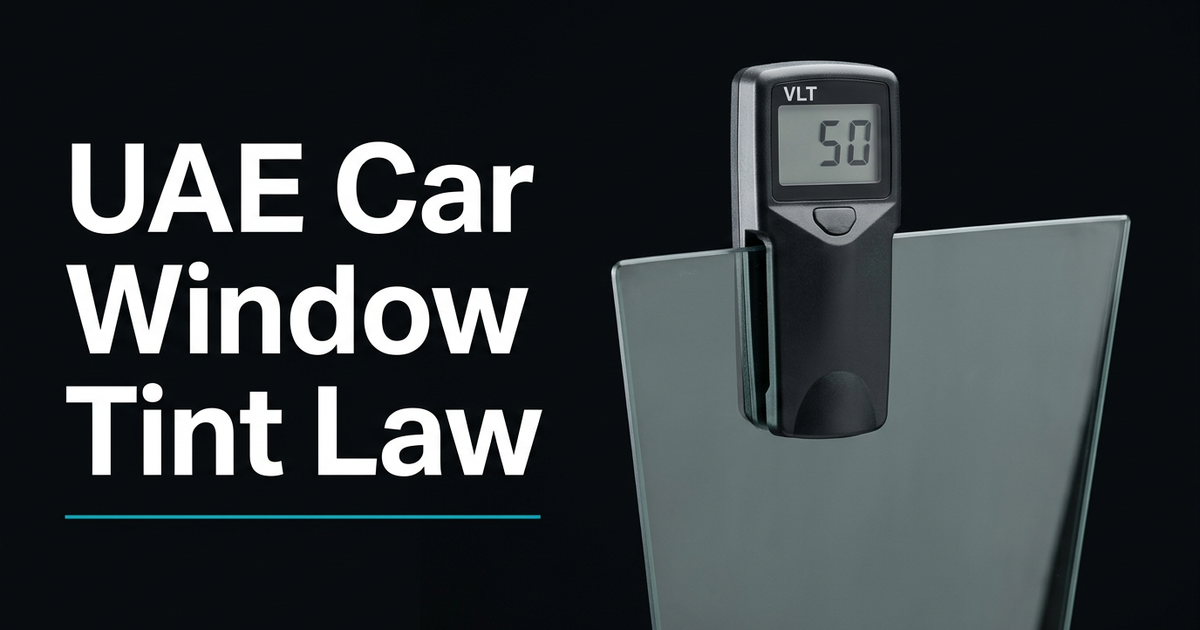
Privately registered vehicles may be tinted so that at least 50% of visible light passes through the side and rear windows. This is the figure set by Ministerial Resolution No. 178 of 2017, which raised the permitted level from the earlier 30% limit, and traffic enforcement now sits under Federal Decree-Law No. 14 of 2024 on Traffic Regulation.
The wording matters, because the industry and the law count in opposite directions:
- VLT (Visible Light Transmission) is the share of light that *passes through*. Higher number = lighter glass.
- Shop shorthand — "35% tint", "20% tint" — refers to the same VLT scale, so a *lower* number is a *darker* film.
So "50%" is not a midpoint you can go either side of. It is a floor. Anything below 50 VLT is outside the limit for a private car.
Can you tint the front windshield in the UAE?
No. The front windshield is not permitted to carry a tint film. The one common exception is the shade band across the top of the windshield — the strip most manufacturers already fit, which sits above the driver's normal line of sight.
This is the single most expensive misunderstanding we see. A full windshield film is immediately visible to any patrol, it cannot be argued down with a meter reading, and it has to come off before the car will clear inspection.
Heat through the windshield is a real complaint, and it has a legal answer: a clear or near-clear film engineered for infrared rejection. These sit well above 50 VLT — some above 70 — while still cutting a substantial share of the heat load, because most of the heat arrives as infrared rather than visible light. The performance figure to ask for is on the manufacturer's spec sheet; treat any number quoted verbally, by anyone, as marketing until you have seen it in writing.
What is the fine for illegal window tint?
AED 1,500. UAE police have issued public warnings against increasing tint beyond the permitted level, reported by Khaleej Times, and Abu Dhabi authorities have confirmed the same figure alongside the 50% ceiling, reported by Gulf News.
Two practical points that cost more than the fine itself:
- The film has to be removed. The fine does not license the tint. Stripping a full set of windows and cleaning off the adhesive is billable work, and it is entirely avoidable.
- Enforcement practice varies by emirate. Abu Dhabi handles tinting on a permission basis, and vehicle categories are treated differently. If your car is registered in one emirate and driven mainly in another, the stricter reading is the safe one to plan around.
Which vehicles are treated differently?
The 50% rule is written for privately registered cars. Several categories sit outside it:
- Taxis, buses and many commercial or company-registered vehicles are subject to tighter limits, and in some cases are not permitted tint at all.
- Rental and fleet vehicles follow the registering company's category, not the driver's preference.
- Medical exemptions exist and are granted case by case on documented medical evidence, through the relevant traffic authority — not through the fitting shop.
- Diplomatic and government vehicles may hold specific permits.
If your car is registered to a company rather than to you personally, confirm its category before choosing a film. That single question prevents most of the fleet-vehicle problems we see.
Does factory privacy glass count toward the limit?
Yes — and this is the detail that catches out SUV and 4x4 owners.
Many vehicles leave the factory with deeply pigmented rear glass ("privacy glass") already fitted to the rear doors, quarter windows and tailgate. The glass itself is dark before any film is applied. A meter does not distinguish between glass and film; it reads the total light passing through the assembly.
The consequence is straightforward. A film that measures comfortably legal on clear front door glass can push already-dark rear glass below the threshold. On these cars the front doors and the rear are effectively two different jobs, and treating them as one is how a car ends up half-compliant.
Before committing to any film, ask for a meter reading on your own glass, panel by panel. A shop that fits tint without a meter is guessing on your behalf.
Not sure where your car sits? Bring it in for a free VLT check — we measure each window and tell you what it reads, whether or not you buy anything.
Message us on WhatsAppHow do you check your tint before an inspection?
- Get a meter reading per window. Side and rear are what matter; the windshield is pass/fail on whether a film is present at all.
- Check the rear separately. As above, factory privacy glass changes the maths.
- Look for reflectivity, not just darkness. Mirrored and metallic-looking films are prohibited on their appearance, independent of what they transmit.
- Keep the film's documentation. A spec sheet naming the VLT of the product fitted is worth having when a reading is borderline.
- Deal with borderline readings before the test, not after. A reading at or just under the line is a decision to make in the workshop, not at the inspection lane.
Films degrade. Older dyed films drift darker and purple as the dye breaks down under UV, so a car that passed when the film was new is not guaranteed to read the same several summers later. That is worth knowing on any used car you did not tint yourself.
Frequently asked questions
What is the legal tint percentage in the UAE? At least 50% VLT on side and rear windows for privately registered vehicles, set by Ministerial Resolution No. 178 of 2017. Films marketed as 35%, 20% or 5% fall below that limit.
Can I tint my front windshield in the UAE? No. A tint film on the front windshield is not permitted, apart from the factory shade band across the top edge. Clear infrared-rejecting films that stay above the legal transmission level are the legal route to cutting windshield heat.
How much is the fine for illegal tint in the UAE? AED 1,500, and the film must be removed. Enforcement practice differs between emirates, with Abu Dhabi operating on a permission basis.
Is 50% tint dark enough to make a difference in UAE summer? Yes, when the film is chosen for heat rejection rather than darkness. Most solar load arrives as infrared, not visible light, so a film's infrared performance matters more than how dark it looks. Ask for the manufacturer's spec sheet.
Does factory privacy glass on my SUV count? Yes. A VLT meter reads glass and film together, so already-dark rear glass leaves much less headroom for additional film than clear front glass does.
Are there exemptions for medical reasons? Yes, granted case by case by the relevant traffic authority on documented medical evidence. It is applied for through the authority, not arranged by a fitting shop.
Check your tint before it costs you AED 1,500
We will measure every window and tell you exactly what it reads — free, and with no obligation to fit anything. If it is legal, you will hear that too.
Armor Car Care Center — Basement Parking, 06 Mall, Al Badee Rd, Al Juraina, Sharjah Tel: +971 58 211 8700
Choosing a film rather than checking one? Start with the tinting options we fit, or read PPF vs ceramic coating vs polishing if you are weighing tint against the other protection on your list. If paint protection is the actual question, how to choose the right PPF covers that side. Ready to book? Book a slot.